

Media
Highlights of Constitution Day 2025 Celebrations at Alliance University by Alliance School of Law
26 November, 2025


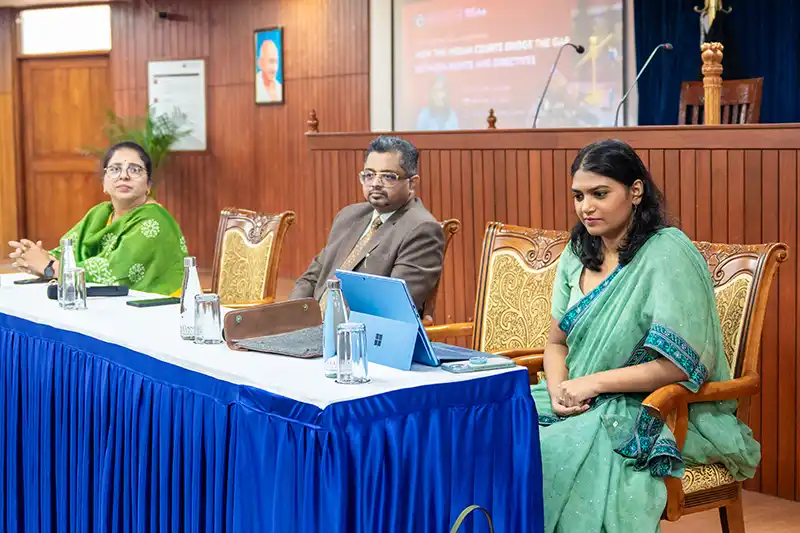

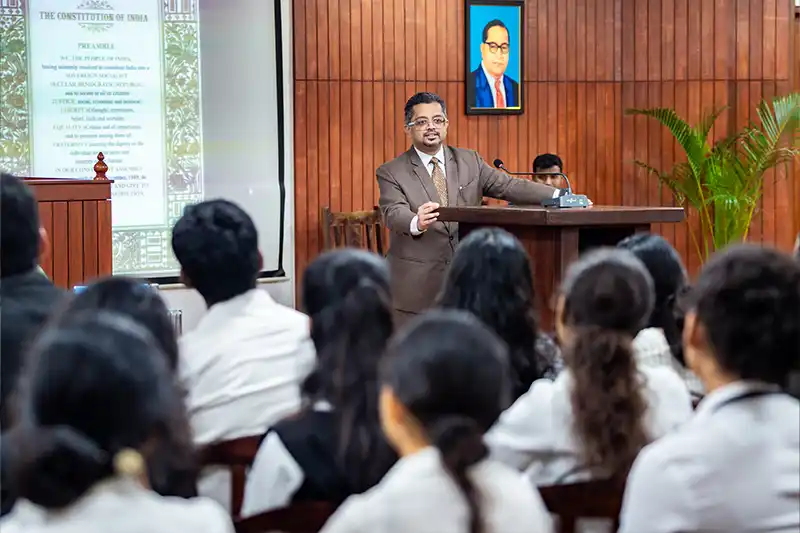

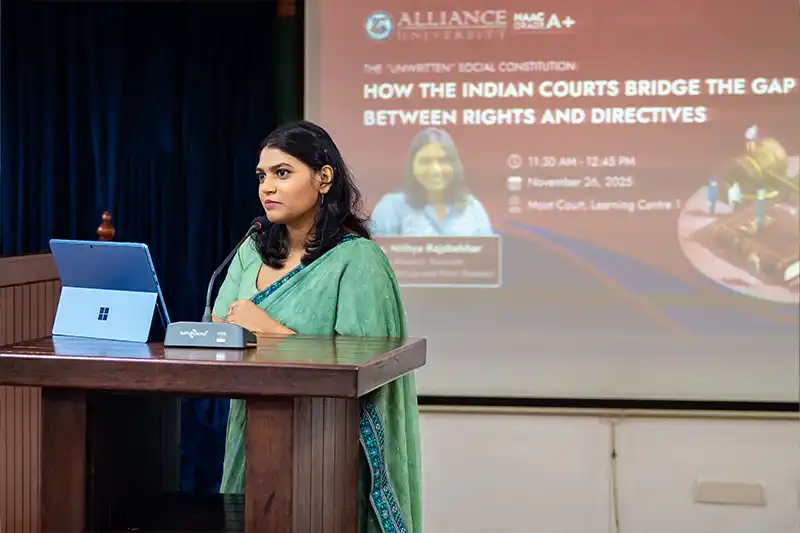
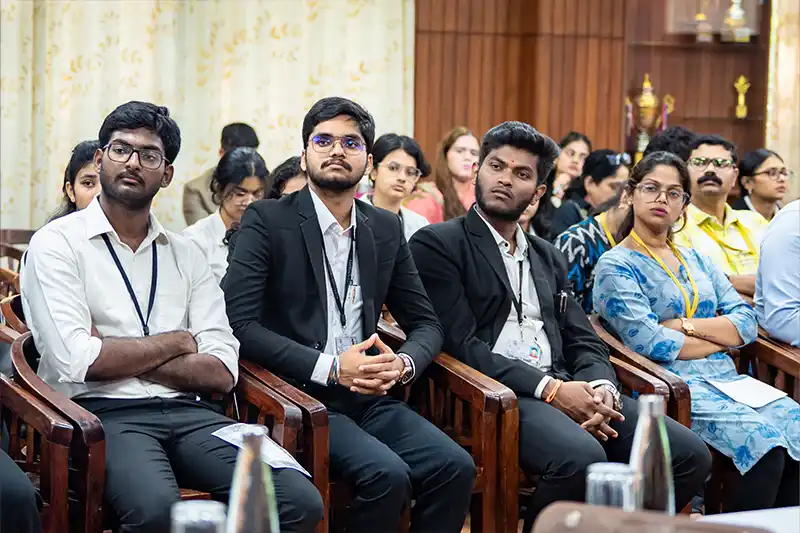

Constitution Day 2025 at the Alliance School of Law, Alliance University, was observed through a series of events that highlighted the intellectual, civic, and pedagogical significance of the Indian constitutional tradition. The events on 26 November sought to engage students and faculty not only in a commemorative exercise but also in a substantive reflection on the operation and evolution of constitutional norms in India.
To emphasise the values embodied in the Constitution and to pledge adherence to constitutional morality, the Dean, faculty members, and students participated in a collective reading of the Preamble. Although such readings are sometimes viewed as ceremonial, this exercise underscored the Preamble’s role as the conceptual and normative anchor of the Indian constitutional framework. Its articulation of justice, liberty, equality, and fraternity has long shaped constitutional doctrine and continues to guide judicial reasoning. Through this public reading, participants reaffirmed their commitment to these foundational principles and highlighted the enduring relevance of constitutional ideals within legal education and institutional practice.
Senior Advocate C. K. Nandakumar delivered a lecture titled “Methods of Interpreting the Constitution: Text, Context, and Transformation.” His talk provided a structured account of the primary interpretive methodologies that inform Indian constitutional adjudication. He examined textual interpretation as the starting point for judicial analysis, while noting that the Constitution’s open textured language often requires an understanding of historical circumstances, institutional design, and social context. He then addressed the idea of transformative interpretation, explaining how the Constitution’s aspirational character allows the judiciary to respond to evolving social needs while maintaining fidelity to constitutional structure. His lecture demonstrated that interpretive methods do not function in isolation but operate interactively within the broader constitutional scheme.
The event continued with a lecture by Nithya Rajshekhar, Senior Research Associate at the Centre for Law and Policy Research, titled “The Unwritten Social Constitution: How the Indian Courts Bridge the Gap Between Rights and Directives.” Her analysis highlighted the complex relationship between Fundamental Rights and Directive Principles in Indian constitutional practice. She argued that, although the Directive Principles are formally non justiciable, they serve as an important source of normative guidance. Courts have frequently relied on these principles to elaborate the scope of Fundamental Rights, particularly in matters concerning socio economic justice. Her lecture emphasised that constitutional meaning develops not solely through textual interpretation but also through institutional practice, public expectations, and broader social engagement. This perspective underscored the presence of an unwritten social constitution that interacts with the formal text.
As part of the day’s activities, students of the Alliance School of Law recorded individual readings of the Preamble and uploaded them to the Government of India’s Constitution Day portal. This initiative supported a nationwide effort to promote constitutional awareness and encouraged students to engage directly with the constitutional text.
Taken together, the 2025 Constitution Day events at the Alliance School of Law demonstrated an integrated approach to constitutional pedagogy. The combination of reflective practice, scholarly engagement, and civic participation underscored the importance of understanding the Constitution not only as a legal document but also as a dynamic framework shaped by interpretive methods, institutional behaviour, and public involvement.
The faculty coordinators for the event were – Dr. Vedashree A, Kirthan Shenoy, and Nikhil Erinjingat.
