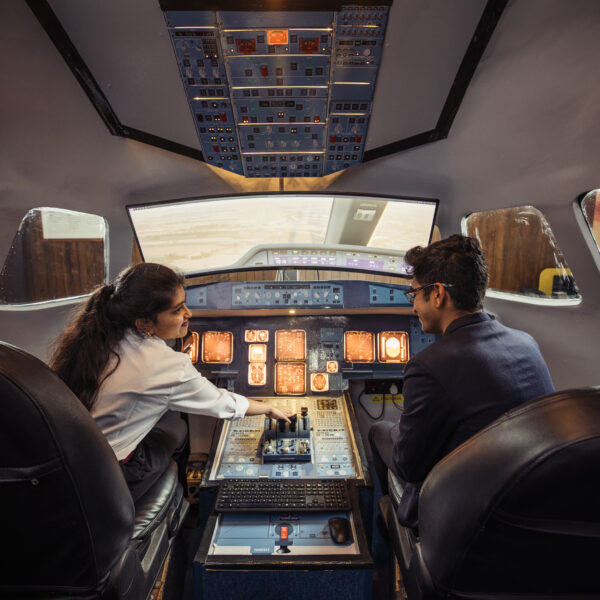
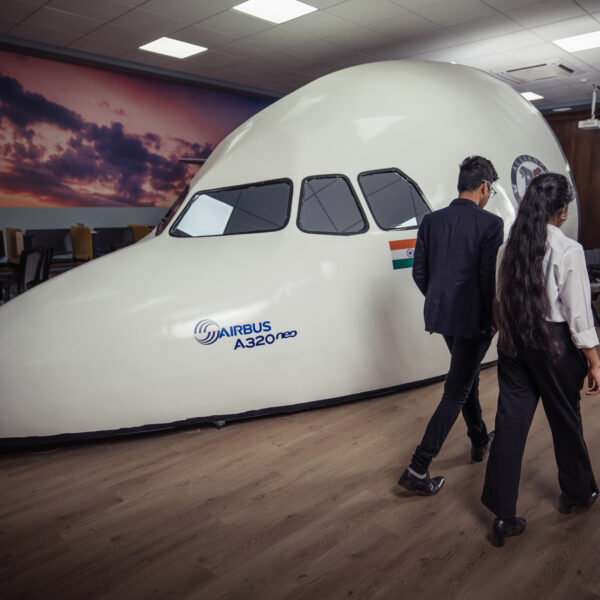
The BSc Aviation/ Aeronautical Science + CPL Integrated Program at Alliance University, Bengaluru, offered in collaboration with MH Cockpit Aviation, prepares students to become professional pilots through a structured and industry-aligned pathway.
Designed for those who want to combine academic aviation education with practical flight training, the programme integrates ground school preparation, simulation-based learning, and guided flying pathway support.
Students build a strong foundation in aviation science, DGCA ground subjects, and flight operations, progressing from classroom to cockpit through a single, time-efficient route.
‹ PREV
NEXT ›
University Core
The B.Sc. Aviation Aeronautical Science curriculum includes compulsory and multidisciplinary learning components that provide students with broader academic knowledge alongside aviation studies. These include areas such as Mathematics, Principle of Management, Environmental Studies, Universal Human Values, and Indian Knowledge System. These courses support the wider academic development of students alongside their professional aviation education.
Majors
The B.Sc. Aviation Aeronautical Science programme focuses on aviation as the primary area of study, with professional core courses covering flight operations, aircraft systems, aviation safety, navigation, airport and airline operations, aviation regulations, and related technical areas. Students progressively study subjects such as General Navigation, Flight Planning and Monitoring, Mass and Balance, Aircraft Systems and Sensors, Operational Control Centre, Airport and Airline Operations Management, Civil Aviation Requirements and Safety Management System, Aviation Safety and Security Management, and Airport Operation Control Centre and Fleet Scheduling.
Minors
The B.Sc. Aviation Aeronautical Science course catalogue does not separately specify a Minor pathway for the three-year B.Sc. Aviation Aeronautical Science programme. The curriculum instead provides Professional Elective Cross Disciplinary Courses through which students can study additional aviation-related areas according to the prescribed elective structure.
Double Major Pathway
The B.Sc. Aviation course catalogue does not separately specify a Double Major pathway for the three-year B.Sc. Aviation programme. The programme follows a dedicated aviation curriculum with Professional Core, Compulsory Courses and Languages, Professional Elective Cross Disciplinary Courses, Multidisciplinary Courses, Skill Enhancement Courses, Internship, and Audit Courses.
Open Electives
The B.Sc. Aviation course catalogue does not separately specify an Open Elective category for the three-year B.Sc. Aviation programme. Students instead have Professional Elective Cross Disciplinary Courses as part of the prescribed curriculum.
PEO (Program Educational Objectives)
PEO 1:
Graduates shall demonstrate strong technical knowledge and operational proficiency in aviation systems, safety, and air transport management.
PEO 2:
Graduates shall uphold the highest standards of aviation safety, ethical responsibility, and sustainable practices in professional decision-making.
PEO 3:
Graduates shall communicate clearly and collaborate efficiently in multidisciplinary aviation environments.
PEO 4:
Graduates shall engage in continuous professional development, adapt to technological advancements, and contribute effectively within the global aviation industry.
PSO (Program Specific Outcomes)
PSO 1:
Apply core concepts of aerodynamics, aircraft systems, air navigation, and meteorology to support safe and efficient flight operations.
PSO 2:
Demonstrate the ability to analyze operational requirements and manage airport, airline, and ground handling functions using modern aviation technologies and regulatory frameworks.
PSO 3:
Implement safety management systems (SMS), risk assessment procedures, and national and international aviation regulations to ensure operational safety and compliance.
PSO 4:
Explore advancements such as avionics systems, unmanned aerial systems (UAS), sustainable aviation practices, and digital aviation technologies while demonstrating analytical and research capabilities.
PO (Program Outcomes)
PO1: Understand core principles of aerodynamics, aircraft systems, meteorology, navigation, and aviation regulations.
PO2: Demonstrate proficiency in flight operations, airport management, aviation safety procedures, and regulatory compliance.
PO3: Apply aviation theories and technical knowledge to real-world operational and safety challenges.
PO4: Analyze complex aviation scenarios and implement effective, safe, and timely solutions.
PO5: Identify potential risks and apply safety management systems (SMS) to ensure operational reliability.
PO6: Adapt to emerging aviation technologies, digital systems, and global industry advancements.
PO7: Understand aircraft instruments, avionics, air traffic systems, and airport infrastructure.
PO8: Comprehend national and international aviation standards, policies, and environmental regulations.
PO9: Exhibit effective communication and coordination skills in multicultural and multidisciplinary aviation environments.
PO10: Recognize aviation’s impact on society and environment, promoting sustainable air transport practices.
PO11: Demonstrate leadership, discipline, and ethical responsibility in aviation operations.
PO12: Apply analytical methods and research skills to improve aviation efficiency, safety, and innovation.
Foundation Core
The foundation stage of the B.Sc. Aviation Aeronautical Science programme develops fundamental knowledge in aviation, science, communication, and technical skills. Students are introduced to the airline industry, physics, mathematics, principles of flight, aviation data analytics, computing, meteorology, radio telephony, and professional communication. These subjects establish the academic and technical base required for further study in aviation.
Open Electives Languages (OEL)
The B.Sc. Aviation curriculum includes language courses as part of its Compulsory Courses and Languages component. Students can study languages including Kannada, Hindi, and French across the first three semesters.OEL List
OEL–I: Language Foundations
- French Language and Culture - I
- Hindi Language and Culture - I
- Kannada Kaushala - I
OEL–II: Language Proficiency Enhancement
- French Language and Culture - II
- Hindi Language and Culture - II
- Kannada Kaushala - II
OEL–III: Advanced Language Study
- French Language and Culture - III
- Hindi Language and Culture - III
- Kannada Kaushala - III
Ability Enhancement Courses (AEC)
The B.Sc. Aviation course catalogue does not separately specify an Ability Enhancement Course (AEC) category. Communication and professional development are included through courses such as Communicative English, Professional Communication, and Soft Skills & Personality Development.
Skill Enhancement Courses (SEC)
Skill Enhancement Courses focus on practical, technical, professional, and application-oriented learning. These courses provide students with computing skills, industry exposure, entrepreneurship knowledge, artificial intelligence applications, project experience, and workplace training.
SEC List
- Introduction to Computing Skills
- Industry Integration & Skill Development
- Industrial Tour Summer Term
- Entrepreneurial Development
- Artificial Intelligence and Its Application in Aviation
- Mini Project
- On Job Training Apprenticeship Startup
These SEC courses are distributed across the programme and include practical and industry-oriented learning.
Recognising Effort, Celebrating Success
01
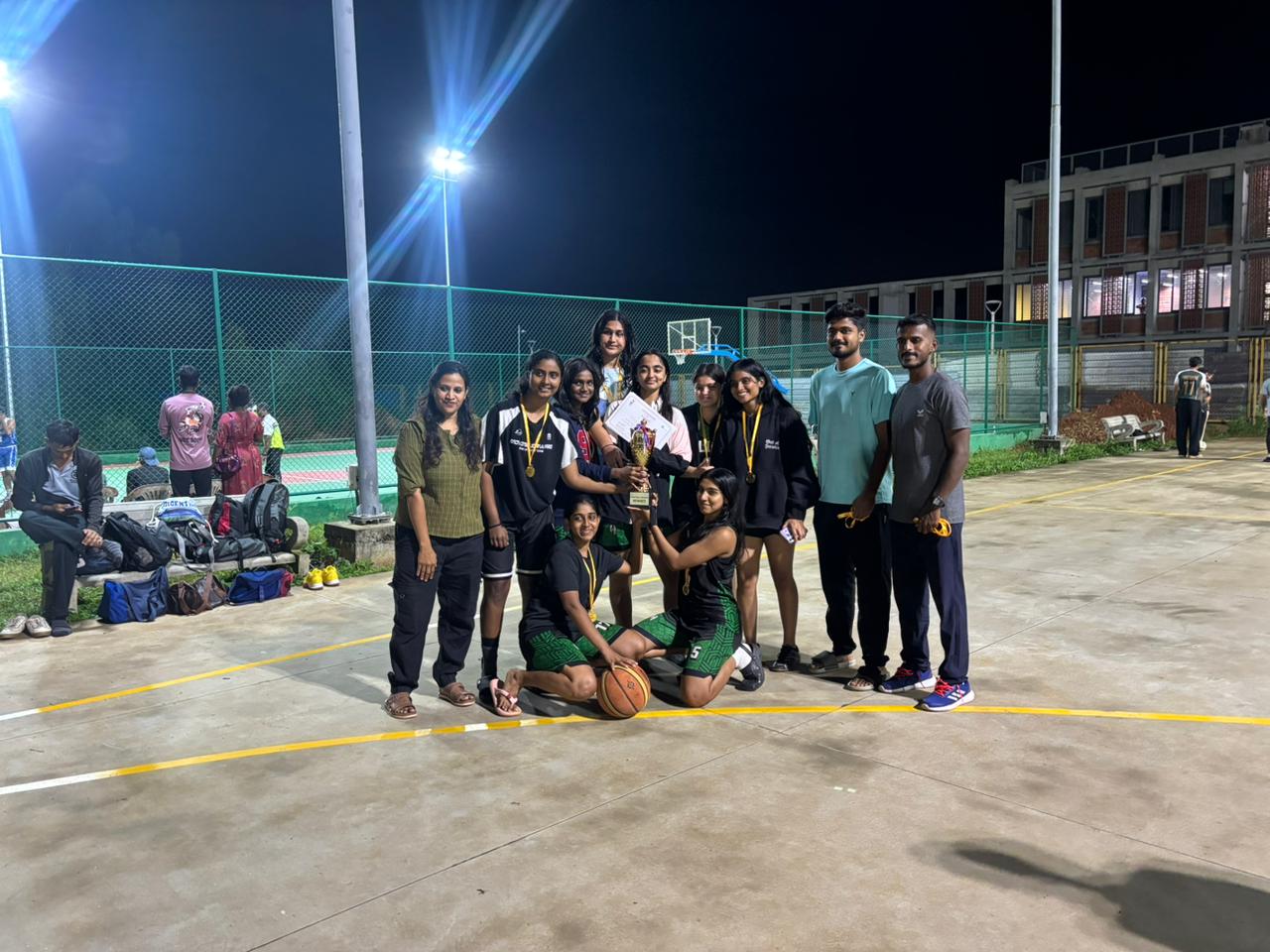
Azim Premji - Basketball Women
02

IIIT-B Runners - Basketball Womens
03

Battle Of Bands - Amrita University
04
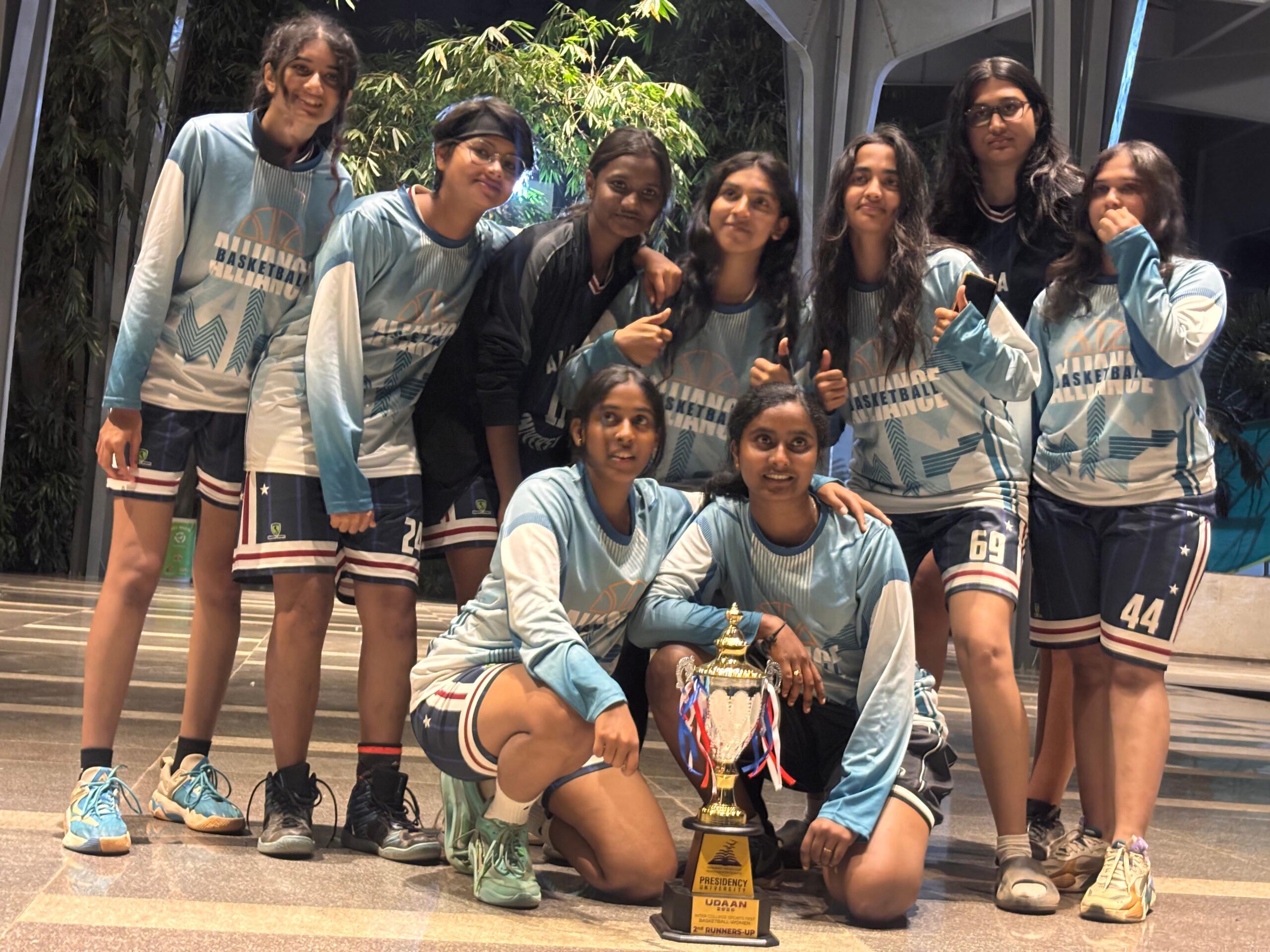
UDAAN presidency University _Womens basketball team secured 3rd place
05
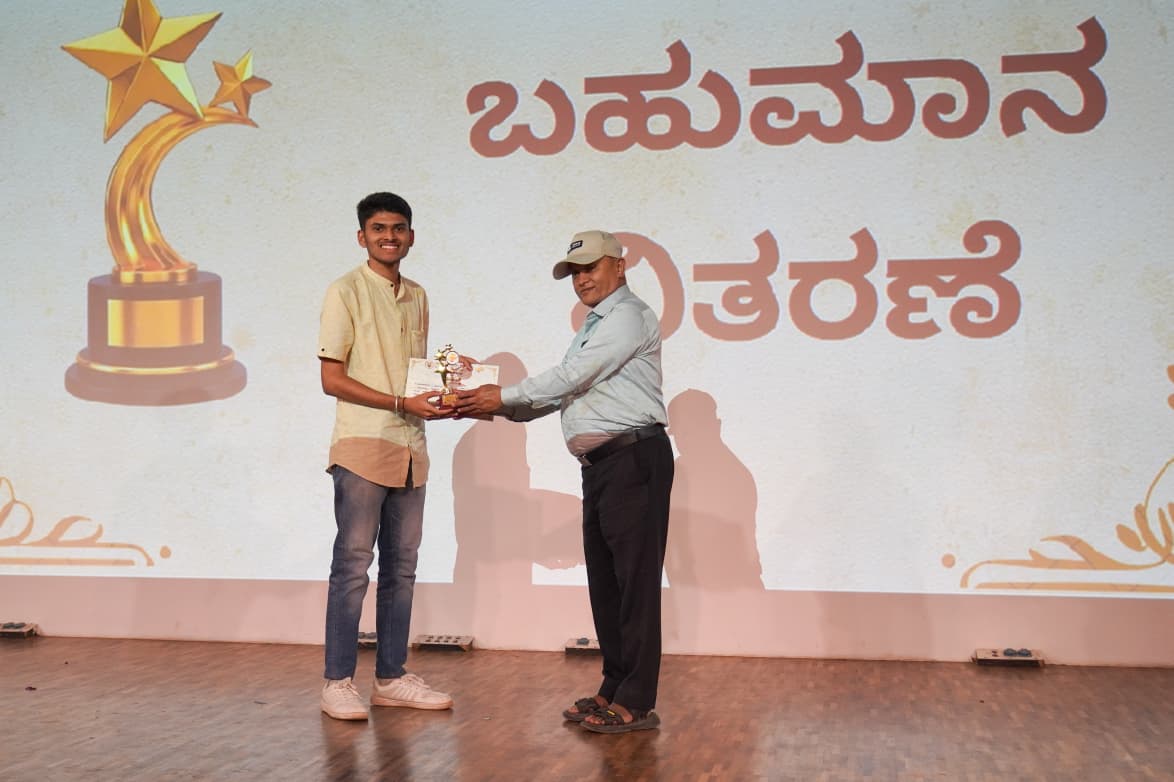
ANIKETHANA 2026_MCC
| Category | Eligibility Criteria |
|---|---|
| General | – Passed 10+2 from a recognized Board / Council – Minimum 50% aggregate marks – Science stream preferred (Physics & Mathematics desirable) |
| Reserved Categories (SC/ST) | – 5% relaxation in minimum marks (i.e., 45% instead of 50%) |
Program duration
| Entry Level | Program Duration |
|---|---|
| Entry Level | Three Years / Six Semesters |
| Particulars | Indian Nationals | Foreign Nationals |
|---|---|---|
| Registration Fee (Fee for Learners Value Proposition Course Virtual) | ₹25,000 | US$500 |
| First Installment | ₹2,75,000 | US$3,350 |
| Second Installment | ₹3,00,000 | US$3,825 |
| Third Installment | ₹3,00,000 | US$3,825 |
| Total Program Fee (Includes registration + all installments) | ₹9,00,000 | US$11,500 |
| Category | Eligibility | Scholarship |
| AUSAT | AUSAT ≥ 90% + XII ≥ 80% | 25% Tuition Fee Waiver |
| AUSAT | AUSAT ≥ 80% + XII ≥ 75% | 15% Tuition Fee Waiver |
| AUSAT | AUSAT ≥ 70% + XII ≥ 70% | 10% Tuition Fee Waiver |
| AUSAT | AUSAT ≥ 90% + XII ≥ 60% | ₹50,000 Freeship |
| AUSAT | AUSAT 80–89.99% | ₹25,000 Freeship |
| Inclusion Support | International-Level Sportsperson | 100% Waiver |
| Inclusion Support | National-Level Sportsperson | 50% Waiver |
| Policy | Conditions | Awards subject to Scholarship Committee review; limited freeships available on a first-come-first-served basis. |
Educational Loan Assistance
Explore scholarships, financial aid options, and loan assistance programs that help make quality education accessible, affordable, and achievable for students from diverse backgrounds.
| Steps | Description |
|---|---|
| Step 1 | Submit Online Application |
| Step 2 | Pay Application Fee — ₹1000 (US$50 for foreign nationals) |
| Step 3 | Appear for AUET – Alliance University Entrance Test |
| Step 4 | Personal Interview |
| Step 5 | Final Selection based on overall performance |
Living Spaces That Inspire Belonging
EXPLORE OUR HOSTELS
Comfort, safety, and community form the foundation of campus living. Our residential halls are thoughtfully designed to create a sense of belonging—offering a welcoming environment where students can study, unwind, and build lifelong friendships.

Separate hostels
for boys and girls
Student-friendly
common areas
Spacious rooms
(single, double, or triple occupancy)
Dedicated wardens
and support teams

Real Stories, Real Impact
STUDENT
No testimonials found.
Everything You Need to Know
1.What is the BSc Aviation/ Aeronautical Science + CPL Integrated Program?
It is an integrated pathway that combines a BSc Aviation/ Aeronautical Science degree with ground school and flight training toward a Commercial Pilot License (CPL).
2.Where is the BSc Aviation/ Aeronautical Science + CPL program offered?
The program is offered at Alliance University, Bengaluru, in collaboration with MH Cockpit Aviation.
3. When do students start flight training?
Students begin flight training from Year 3, Semester 5, while continuing their academic studies.
4. How many flying hours are required for the CPL pathway?
The program provides a flying pathway toward completing the 200 flying hours required for CPL, subject to applicable DGCA requirements.
5. What qualifications do students receive after completing the program?
Students graduate with a BSc Aviation/ Aeronautical Science degree and can pursue CPL eligibility subject to meeting the applicable DGCA requirements.
6. What is the duration of the BSc Aviation/ Aeronautical Science degree?
The degree component is completed over 3 years. Flight training may continue beyond the degree depending on factors such as weather, aircraft availability, instructor availability and DGCA processes.
7. What are the eligibility requirements for the integrated program?
Students should have completed 10+2 from a recognised board with a minimum of 50% aggregate. Physics and Mathematics are preferred, and students must meet the applicable DGCA eligibility requirements for CPL training.
8. What type of training is included in the program?
The program combines academic aviation education, ground school training, simulation-based learning, flying pathway support and real aircraft exposure.
9. Can students pursue aviation careers if their CPL training takes longer?
Yes. Students still graduate with a BSc Aviation/ Aeronautical Science degree, which can support careers in areas such as airport operations, airline ground operations, aviation management, safety and compliance.
10. Does completing the integrated program automatically grant a Commercial Pilot License?
No. Students must complete the applicable flight training, examinations, medical requirements and other DGCA requirements for CPL eligibility. The program provides the academic and training pathway toward the CPL.